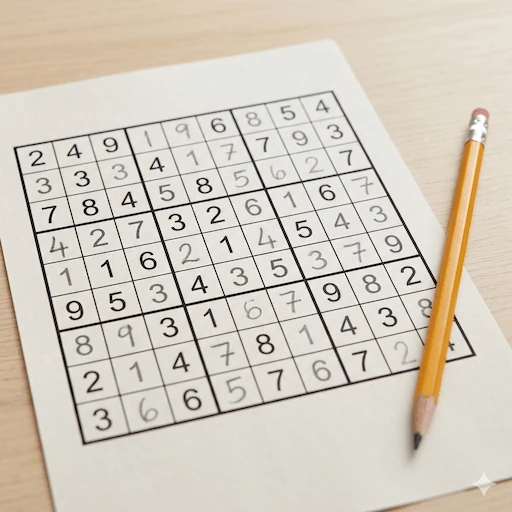
In the world of puzzles, few games have achieved the global cult status of Classic Sudoku. It is a staple in newspapers, a go-to app for commuters, and a quiet ritual for millions. But Sudoku is not a math game—it is a test of deductive logic.
Whether you are a seasoned player or just getting started, understanding the history and cognitive science behind the 9x9 grid can improve how you play.
1. The Surprising History: Why the Name Is Japanese but the Roots Are Global
- 18th century: Mathematician Leonhard Euler developed Latin Squares, the mathematical foundation of Sudoku.
- 1979: American architect Howard Garns published the modern form as "Number Place."
- 1984: Japanese publisher Nikoli popularized the game as Sudoku, short for "the digits must remain single."
2. Why Sudoku Is Brain Food
Working Memory and Neuroplasticity
You constantly track candidates and constraints. That process trains working memory and supports neuroplasticity.
Flow State and Stress Relief
Sudoku creates deep focus. Many players use it as active meditation to reduce mental noise and anxiety.
3. Three Practical Strategies
- Eliminate first: Use rows, columns, and boxes to remove impossible positions.
- Use naked pairs: Two cells sharing the same two candidates let you eliminate those values elsewhere.
- Avoid guessing: A valid Sudoku can be solved logically. Guessing often creates dead ends later.
4. Why Play on SimFuns
- No distractions: No pop-ups, no mid-game interruption.
- Clean interface: Optimized for both desktop and mobile focus sessions.
- Localized experience: Available in 8 languages for global players.
Ready to sharpen your logic? Play Classic Sudoku on SimFuns for free.