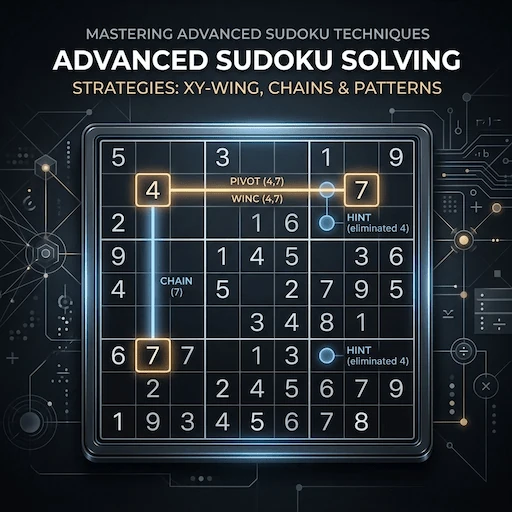
Sudoku is a logic-based puzzle that rewards structured thinking rather than guessing. In this weekly deep-dive guide, we will explore a complete progression of solving techniques—from basic singles to advanced chain strategies such as XY-Wing and forcing chains.
1. Understanding the Foundations
Every Sudoku puzzle operates under three fundamental constraints: each row, column, and 3×3 box must contain digits from 1 to 9 without repetition. While these rules are simple, the complexity arises from how these constraints interact across the grid.
The key to solving Sudoku efficiently is not brute force, but systematic elimination. Every number placed reduces possibilities elsewhere, creating a chain reaction of logical deductions.
2. Beginner Techniques
Naked Single
When a cell has only one possible candidate left, it must be that value. This is the simplest and most direct solving technique.
Hidden Single
A number may appear multiple times as candidates in a row, but if it can only go in one position, it is a hidden single.
Mastering these two techniques is essential, as they form the foundation for all advanced strategies.
3. Intermediate Techniques
Naked Pair / Triple
When two or three cells share identical candidate sets, those numbers can be eliminated from other cells in the same unit.
Pointing Pair
If a candidate is confined to one row or column within a box, it can be eliminated from the rest of that row or column.
These techniques introduce the concept of interaction between rows, columns, and boxes.
4. Advanced Pattern Techniques
X-Wing
X-Wing occurs when a candidate appears exactly twice in two rows and aligns in the same columns, forming a rectangle. This allows elimination in those columns outside the pattern.
Swordfish
Swordfish extends X-Wing to three rows or columns, creating a more complex elimination pattern.
These techniques require pattern recognition rather than simple scanning.
5. Chain Techniques
XY-Wing
XY-Wing involves three cells: a pivot and two wings. By analyzing their relationships, you can eliminate candidates that see both wing cells.
XYZ-Wing
A variation where the pivot cell contains three candidates, allowing more complex eliminations.
Simple Chains
Chains are sequences of strong and weak links. By alternating these links, you can deduce contradictions and eliminate candidates.
Forcing Chains
This method assumes a candidate is true and follows the logical consequences. If a contradiction arises, the candidate is false.
Chain techniques are among the most powerful tools for solving expert-level Sudoku puzzles.
6. Expert-Level Thinking
At advanced levels, Sudoku becomes less about individual moves and more about recognizing global structures.
- Pattern recognition over scanning
- Logical deduction over guessing
- Efficiency over brute force
7. Practical Strategy for This Week
This week's Sudoku challenge focuses on medium-to-hard difficulty. Players should prioritize:
- Candidate elimination early
- Identifying pairs and patterns
- Using chains when stuck
8. Conclusion
Sudoku mastery is built on structured thinking and consistent practice. By progressing from basic techniques to advanced chains, you can solve even the most difficult puzzles logically and efficiently.
Ready to test your skills? Play Sudoku Now