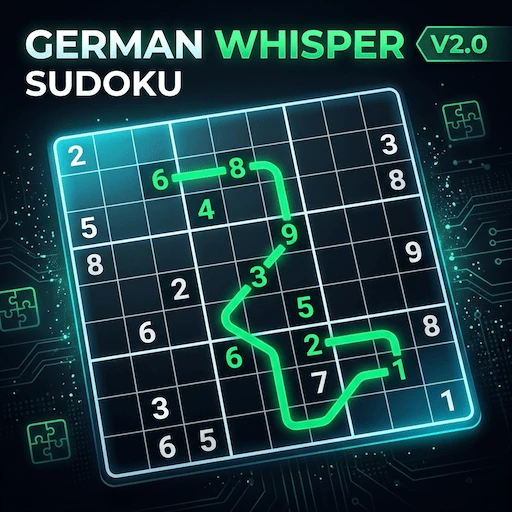
1. What Is German Whisper Sudoku?
In German Whisper Sudoku, green lines are drawn across the grid. The core rule is simple: adjacent digits along any green line must differ by at least 5.
For example, if a cell on a line contains a 2, its neighbor on that line could be 7, 8, or 9 (since 7-2=5, 8-2=6, and 9-2=7). It could NOT be 1, 3, 4, or 6.
2. The Polarity Principle: High vs Low
Because the difference must be at least 5, digits naturally split into two groups:
- Low Digits (1, 2, 3, 4)
- High Digits (6, 7, 8, 9)
A Low digit must always be adjacent to a High digit, and vice versa. This creates an alternating "Low-High-Low-High" pattern along the entire line. This is the most powerful tool in solving these puzzles.
3. The "Missing" 5
You may have noticed that 5 is missing from the groups above. This is because 5 cannot differ by at least 5 from any other digit between 1 and 9 (the maximum difference is 4, with 1 or 9). Therefore, the digit 5 can never be placed on a German Whisper line. It can only appear in the empty cells around the lines.
4. Key Strategies for Beginners
Use Coloring
Since the line alternates between High and Low, you can "color" the cells. Even if you don't know the exact digits, you know that if one cell is "Blue" (Low), the next must be "Red" (High). This helps you see contradictions across rows and columns quickly.
Check the 4s and 6s
The digits 4 and 6 are the most restrictive. A 4 on a line must be next to a 9 (because 9-4=5, and no other digit works). Similarly, a 6 must be next to a 1. Finding these "anchors" often unlocks the entire line.
5. Conclusion
German Whisper Sudoku is a beautiful marriage of geometry and logic. By mastering the High-Low polarity and identifying restrictive digits like 4 and 6, you will be able to solve even the most complex whisper puzzles with ease.