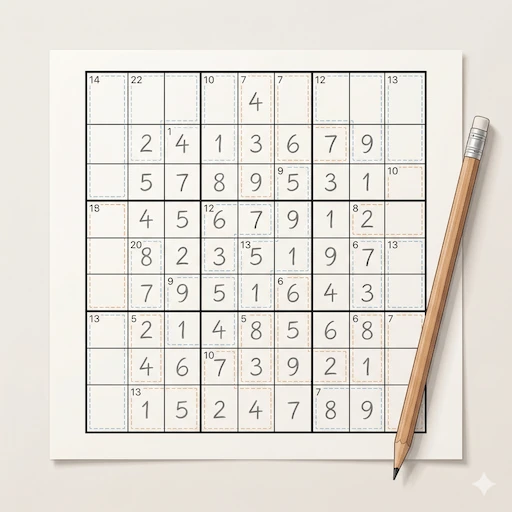
Killer Sudoku is one of the most challenging and rewarding variations of classic Sudoku. Unlike standard puzzles, it introduces cages—groups of cells with a defined sum—which adds an extra layer of logic and complexity. In this complete guide, you will learn how to solve Killer Sudoku cages step by step, from basic techniques to advanced strategies used by expert players.
1. What Are Killer Sudoku Cages?
A cage in Killer Sudoku is a group of connected cells with a specified total sum. The numbers within the cage must add up to that amount, and no number can be repeated within the cage.
This means that each cage adds a second constraint on top of the traditional row, column, and box rules, making the puzzle significantly more complex.
2. Basic Cage-Solving Strategies
Understanding Common Sum Combinations
The most important skill for solving Killer Sudoku cages is memorizing common number combinations.
- 2 cells sum to 3 → (1,2)
- 2 cells sum to 17 → (8,9)
- 3 cells sum to 6 → (1,2,3)
- 3 cells sum to 24 → (7,8,9)
These combinations form the foundation of all cage-solving techniques.
Using Minimum and Maximum Limits
Each cage has a minimum and maximum possible sum. By calculating these values, you can eliminate impossible candidates.
3. Intermediate Techniques
Cage Overlap Analysis
When cages cross rows or columns, you can use interaction rules to eliminate candidates.
The 45 Rule (Box Rule)
The sum of numbers 1–9 is always 45. If multiple cages completely cover a row, column, or box, you can subtract known sums to find missing values.
4. Advanced Cage-Solving Strategies
Hidden Cage Constraints
Sometimes the cage structure indirectly limits candidate placement across the grid.
Cage Splitting
Large cages can be divided into smaller logical groups to simplify solving.
Combination Elimination
If certain combinations are impossible due to row/column conflicts, they can be eliminated entirely.
5. Expert Techniques: Chains and Logic
Killer Sudoku Chains
Advanced players use chain logic to connect cage constraints across the grid, forming logical deductions that eliminate candidates.
Forcing Chains
Assume a value in a cage and follow the consequences. If it leads to a contradiction, eliminate it.
6. Common Mistakes
- Ignoring cage sums
- Forgetting the non-repetition rule
- Guessing too early
7. Pro Tips for Faster Solving
- Memorize combinations
- Use pencil marks
- Scan systematically
8. Conclusion
Mastering Killer Sudoku cages requires understanding number combinations, applying logical constraints, and practicing advanced deduction techniques. With consistent practice, even the hardest puzzles become manageable.
Ready to challenge yourself? Play Killer Sudoku Now